What felt like an interminable journey on Route 128, with drivers rolling down their windows to cast spiteful glances, resulted in a crawl into Boston. A final lurch and we were on Commonwealth Avenue, just a few blocks from the Boston Music School. Unlike the somnolent suburb of Wenham, Boston was a cacophony. Cars blared horns as they careened around corners, policemen blew whistles and hollered at pedestrians. Long-haired men with protest signs against the Vietnam War waved two fingers in the air, and shouted "Peace, Man".
"See Margie," said my mother, pointing as we walked. "Over on Newbury Street, is the Berklee College of Music. I studied there for a while, too, in the Adult Program before you were born. Then your father came up with every excuse for me to stop. He said, Frances, you have three children to worry about, and a home to take care of. You're ignoring your responsibilities as a housewife." She shook her head. "I was a young mother those days. Had I known better—" She paused while looking longingly at the row of buildings that belonged to a school.
"My parents were in a hurry to marry me off, I guess. So I became a mother at the age of nineteen." She reached for my hand. "But now your sisters have families of their own, and you know what?"
"What, Mummy?"
"I don't think they need me any longer. To them, I'm a nuisance."
I gave her hand a squeeze, trying to make up for every loss. "No, Mummy, you're not."
She looked at me adoringly. Little tears welled in her eyes. I knew right then and there that I was her last hope.
"I'll channel my energies into you, Sweetheart, and see to it that you have beautiful music in your life. What can your father say to that?"
Behind the double doors of the Boston Music School, a black lady with an Afro sat in the foyer at a large desk. I had never seen a black person except on television. I stared.
"May I help you?"
"We're here for an audition," my mother declared.
The lady smiled and glanced at me. "What instrument do you play, Honey?"
I looked up at my mother.
"She's a violinist, and here to play for Mr. Linwood Scriven."
"Are you sure he's expecting you?"
My mother nodded. "Oh yes. I had telephoned the school earlier, and was given this time."
"Very well. Someone else must have been here when you called. Go on upstairs, then—that away." The woman pointed. Her spangled bracelets jingled.
A broad, winding staircase with a dark banister led to Mr. Scriven's studio on the second floor. My mother, clasping my burnished leather violin case led me up the stairs. "I can't wait for Mr. Scriven to hear you play. This ought to prove that his time spent teaching me was not wasted."
She knocked on his door. It creaked open.
There stood a ghostly figure. Mr. Scriven was so frail and elderly that it seemed we might blow him away with our breath.
"Do you remember me, Mr. Scriven?"
My mother resembled a dancer in her swirly, navy-blue skirt cinched at the waist with a beige, puffy-sleeved blouse. Her thin hair was concealed by a shoulder length brunette wig—the one my father affectionately called the Sophia Loren. Everyone agreed that my mother was beautiful. She had olive skin and almond shaped eyes. Her facial features were delicate and smooth.
Linwood Scriven stared through thick lenses that magnified his blue eyes into jumbo marbles.
"I want you to meet and hear my youngest daughter, Marjorie."
No response.
"She'll play for you," my mother repeated, louder.
My mother's heels clicked against the oak floor. A large bust of Beethoven rested on top of Mr. Scriven's upright piano. Placing my violin case on the piano bench, my mother whispered, "Margie, play the Vivaldi Concerto. Show Mr. Scriven what you can do. He might be just a bit hard of hearing, my dolly, so play strong. It was many, many years ago that I studied with him."
Mr. Scriven tottered to his rocking chair and sat down. I readied my violin and began the opening bars of the Vivaldi. Glancing at Mr. Scriven, his feet tapped the first motive while I played. He hummed the tutti sections.
"You're sweet," he wheezed, after the movement ended. "An angel." He turned to my mother. "I'll be going away to meet my Maker soon. Will you join me?"
My mother gasped.
At that moment, the studio door bolted open. A large-bosomed, white-haired woman with shoes worn by the Wicked Witch of Oz, landed into the room.
"What's happening here?" the old woman asked wringing her hands. My mother shot up from her chair.
"I'm Frances Kransberg, a former pupil of Mr. Scriven's. And this is my almost eight-year-old daughter, Marjorie. She's auditioning—"
"Is that so?" asked the old woman. "I'm Sarah. Linwood's wife. Had I known, I would have auditioned your daughter."
"So you're Mrs. Scriven. I've heard many wonderful reports about your teaching from my friends in Brookline Civic Symphony."
"You're a violinist?"
"An amateur. My daughter is the talented one."
My mother turned to me and coaxed sweetly. "Dolly. Play your concerto again. This time for Mrs. Scriven."
Though it was the last thing I felt like doing. I had no choice but to start over, having been warned by my parents never to argue with either of them in front of others.

I hurried to the last bars of the concerto, lowered the violin, and stared at my feet.
Sarah Scriven bent down to my face.
"So, you want to be a violinist when you grow up?"
I nodded.
"You're a talented young lady. You like to practice?"
"Uh-huh." I lied.
"Because playing the violin takes not only talent but guts, and lots of hard work,"she said.
The unkempt appearance of Mrs. Scriven's whitish hair gave me the giggles.
"What happened to your front tooth?"
"What happened to your front tooth?"
"Fell out."
"Did you get money for that tooth?"
"Naturally," my mother ejaculated. "The tooth fairy always brings gelt."
Their eyes met, and they laughed, having found a common heritage in Judaism.
"Mrs. Scriven, don't you have a phenomenal pupil by the name of Lynn Chang? A Chinese boy?"
Mrs. Scriven tilted her head back and sighed. "I did. A major talent, that Lynn. He's off to Juilliard every Saturday studying with Ivan Galamian."
"How about that," said my mother, sucking in her cheek. "I was hoping my little Marjorie could work with your husband, Linwood, or study with both of you together. You know Sarah, I'll tell you a secret."
My mother's voice dropped to a conspiratorial whisper. "Of all my violin teachers—and I had many, including members of the Boston Symphony—Mr. Scriven was my favorite."
"How's that?" asked Mrs. Scriven, eying my mother cautiously, as if examining a specimen from the Museum of Natural History.
"Well." My mother paused. "Your husband was demanding but kind, exacting but patient. A mensch. I would've thought—I mean, if he hadn't aged so—that he'd be the perfect teacher for my Marjorie."
"Linwood no longer accepts students," Mrs. Scriven snapped. "He's too frail and his mind is going, as you can see. I was Lin's pupil way back when, and then, well, we fell in love and married. But there's a thirty year difference between us. Obviously, I'm willing to take on new students to pass along my husband's repository of knowledge."
"That would be wonderful," my mother gushed. "You were your husband's prize pupil, Sarah, after all. May I call you Sarah? And, as we speak of lineage, I'm aware that your husband studied with a famous pedagogue but I cawn't remember the name—"
"Linwood was a pupil of the eminent French violinist Henri Marteau, who was a pupil of Léonard, a disciple of de Bériot." Mrs. Scriven replied. "That's what's known as yikhus, or pedigree."
My mother and Mrs. Scriven swapped tales peppered in Yiddish. Their heads bobbed at the tempo of Allegro. I didn't like the guttural sound of Yiddish. As they spoke, Mr. Scriven, alone in his rocking chair had slumped forward. Was he dead?
Mrs. Scriven glanced in her husband's direction. "He's like a child nowadays. We enjoyed our music together all those years; I idolized him. He was so devoted." She took out a handkerchief from her pocketbook and blew her nose. "Did you know that Linwood's favorite composer has always been Beethoven? He loves the Violin Concerto for its spirituality. Beethoven soothes the soul."
"I understand," said my mother, softly.
"Life is a circle, Mrs. Kransberg. So sad—"
"So true," my mother agreed.
"It's settled then," Mrs. Scriven said. "Lessons for your daughter beginning this Saturday."
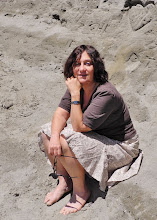
photo of Sarah Scriven and me


