Showing posts with label Gingold. Show all posts

Thursday, June 17, 2010

The Phone Call (Ch.5 Pt.2)

Josef Gingold, formerly concertmaster under George Szell with Cleveland Orchestra, was chamber music professor par excellence at Meadowmount. His studio on the first floor of the Main House was directly opposite Galamian's room. Gingold, having been a protégé of the legendary Belgian violinist Eugene Ysaye, was a much sought after teacher and chamber music coach. Charming and forever patient, his students adored him. Gingold invited everyone to his studio for a warm welcome. "Come children," he said, his voice deep and gruff, "vee'll play chamber music!"
He opened a cupboard filled with sheet music. "Look vot I found. Bach's beloved Brandenburgs!"
Gingold's excitement was infectious. 
"Let's begin with number three."
The students cheered.
 
The newcomers sat on the floor and watched as the older campers, many in college, grouped into a semi-circle—three violinists, three violists, and three cellists.
Lynn Chang sat first chair. I remembered how he tore into the Tchaikovsky Concerto at Boston's Symphony Hall and was curious to hear him play chamber music.
Lynn brimmed with confidence. The house mother's daughter, Stephanie, sat next to him. "Ready?" He darted a sly look around the room.
"Ready!" shouted the students, their bows held in mid air.
The Brandenburg Concerto pulsated with vitality.  

As swirls of rhythm filled Mr. Gingold's studio, a teaching assistant barged into the room, and gestured for the playing to cease. "Is Marjorie Kransberg here? Has anyone seen Marjorie Kransberg?" Mr. Gingold glanced up. His broad smile faded. Lynn Chang stared blankly. The room fell silent.
I couldn't imagine why I was being summoned, and slowly raised my hand. 
"There you are," said the assistant hurriedly. "Marjorie, your father is on the phone. There's been an emergency and he needs to speak with you right away. The pay phone is open in the booth. It's just by the entrance way. Here, I'll show you."
I could feel the blood rush to my head. My mother had died. I just knew it. Why else would my father call? I began to whimper.
My legs, now made of rubber, followed the assistant to the phone booth. Her face darkened as she handed me the phone. She turned around and left me alone in the cubicle.

I held my breath.
"Hu-Hullo?"
"Margie, precious darling—it's Mummy and Daddy. (They were on the phone together). We had to say it was an emergency or else they wouldn't let us speak with you."
Perspiration soaked my shirt. I could hear my father inhale from his cigarette.
"Tell your mother you're ok. She didn't sleep all night worrying that you're homesick, and I'll tell you, your mother is driving me crazy. You are Frances. You're making me—"
"My sweetheart, precious darling, are you alright? Do you miss Mummy and Daddy?"
"No," I said, feigning calm.
"That's funny. Last night, your first night at camp, I sensed that you missed us. I was sick with worry, my dolly. I miss you, I miss you terribly. Do they serve vegetables at Meadowmount? Enough milk? Are you kept warm at night?"
"Yeah," I replied, secretly grateful to know that my mother was worried sick but had not died. "I'm listening to Lynn Chang play the Brandenburg Concerto in Mr. Gingold's studio." 
"The wha?" asked my father, taking another puff of cigarette.  
"Oh, how phenomenal. John, did you hear that?" My mother's voice leaped. "She's with Lynn Chang! I always wanted the two of them to play duets together."
 "Mum, I've gotta go."
"Don't forget to eat your fruits and vegetables. They'll make you strong."
"Frances. This call's costing money. Marjorie, if you should need to reach us, call collect. Say to the operator, I'd like to place a person-to-person call to John Kransberg. Ok, little pisher?"
Mother was about to say something. "Marj—"
"She's fine Furr," I heard my father gasp, and then a click followed by a dial tone.

Thursday, June 10, 2010

Starting Meadowmount (Ch.5 Pt.1)

It was summer of 1970. High school and college students at the Meadowmount School of Music were jittery after the Kent State massacre. They huddled around the one television set in the Recreation Room of the Main House, and listened intently for news updates as President Richard M. Nixon launched a Cambodian invasion. Endless debates ensued regarding the anti-war movement. Being eleven years of age, not only was I oblivious to political events and the world stage, but I was home-sick. I had never in my life been away from my parents, not even for a one night sleep-over. At Meadowmount, a world renown summer school for string players nestled in rural Westport, New York, I felt conspicuously out of place. I didn't know any of the campers or faculty members, and was at the time, the youngest student. I was in awe of the distinguished individuals in Meadowmount's history: Joseph Gingold, Gregor Piatigorsky, Leonard Rose, Itzhak Perlman, Pinchas Zukerman, Michael Rabin, Paul Makanowitzky, and David Nadien, among a long list of others. Ivan Galamian had loosely modeled his Meadowmount after the Stolyarski School in Odessa, which produced a whole galaxy of formidable violinists. In my eleven-year-old mind, I understood that to study at prestigious Meadowmount was a privilege. But, in my eleven-year-old heart, I missed my parents and wished only to return home.

My room was a tiny cubicle directly above Ivan Galamian's teaching studio in the living quarters of the Main House. If I put my ear to the floor, as my mother had insisted before she left, I could hear Mr. Galamian transmit secrets of violin playing to his students. The strains of violin and Mr. Galamian's mutterings wafted up through the vents into my room. "That's the best way to get ahead, my dolly. Get down on the floor and listen, listen, listen. Those are precious secrets to guard for life."


The morning practice regimen began at eight o'clock sharp, and continued until noon. Ten minute breaks were allotted between each hour to rest fingers and ears. They were also a preventative for the harmful habit of mindless practice. I had never studied without my mother's supervision, and as a result, was at a loss for how to begin. Reluctantly, I propped the Galamian scale book on the wire-rimmed music stand. The scales, along with Kreutzer Etudes were mandatory for all first time students. Like many other violinists at Meadowmount, I had been assigned J.S.Bach's Concerto in A Minor, a staple in the repertoire.

The scales perplexed me. The notes rose and fell without stems or bar lines. I let the book drop off the music stand, sat down on my cot, and wept. I missed my mother and father. They may have been nuts, but they were still my parents. During the ten minute breaks, excited chatter crescendo-ed  in the hallway. The Main House students, all girls ages 12 to 15, laughed as they became acquainted with one another. They compared notes about lessons and repertoire, and exchanged anecdotes in an array of dialects. Hesitant to emerge from my cubicle above Mr. Galamian's studio during the breaks, even to use the bathroom, I stifled sobs and waited for the ten minute interval to end. The house mother blew a whistle and hollered, "Back to work, girls!" I gripped my old teddy bear, rather than the violin, and buried my nose in its fur for the scent of home. Before long the stuffed animal was drenched with tears.


After four tedious hours passed, hours which felt like weeks, a blaring alarm rang. "Lunch!" yelled the Main House girls and stampeded down the stairs. I busted out of my cell and raced down the broad, winding staircase to get to the front of the dining hall line. Many hours had passed since breakfast and my stomach growled. Although fearful that I'd have to sit alone again, as I had done at breakfast, or speak with strangers, the aroma of fresh bread and spaghetti with marinara proved a distraction. My mouth watered. I imagined a heaping platter of pasta drowned in rich, chunky tomato sauce with huge, savory meatballs, like my mother's recipe. Just before the dining hall doors opened, I felt a tap on the shoulder. I turned around. A girl that resembled Botticelli's Venus, but dressed in worn-out, bell-bottomed Levis, introduced herself to me.
"I'm Sharan. What's your name?"
I stared back at her. My parents would never have allowed me to wear jeans.
"Certainly you have a name, right?"
"It's Margie."
She blinked. "Smudgie?"
"Margie," I repeated.
"Oh, it's—Mahgie," she seemed to sing. "Are you from Boston? You have a Boston accent."
My face felt flushed.
"Oh, c'mon, don't be shy. At least you don't have an embarrassing hickey on your neck like I do."
"A what?" 
"See?" She pointed under her chin to a bruise.
"Pretty gross, huh. It's from practicing. I know, it looks as if my boyfriend bit me, but trust me, he didn't. I mean, he tried. Do you have a boyfriend?"
My mind reeled. I was too young for boys, and even if I were older, my parents wouldn't have allowed dating. I had a fleeting image of Elliott Markow, though, and how we played duets together in a darkened room at Boston Music School.
"Elliott," I said softly, hoping not to sound like a geek, and for Sharan to like me.
The dining hall doors opened. Everyone cheered and clapped.
"Sit with me at lunch," Sharan said. "There's other stuff besides the violin to learn around here—"
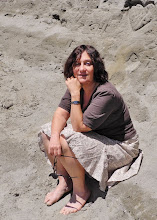
Mom and I at Meadowmount in 1970